Book: The Cave Fauna of California Download free pdf here
The Cave Fauna of California. William R. Elliott, James
R. Reddell, D. Craig Rudolph, G.O. Graening, Thomas S. Briggs, Darrell Ubick,
Rolf L. Aalbu, Jean Krejca, Steven J. Taylor. Proceedings of the California
Academy of Sciences, July 28, 2017. 311 pp., 25 tables, 9 maps, 4 graphs, 105
photos.
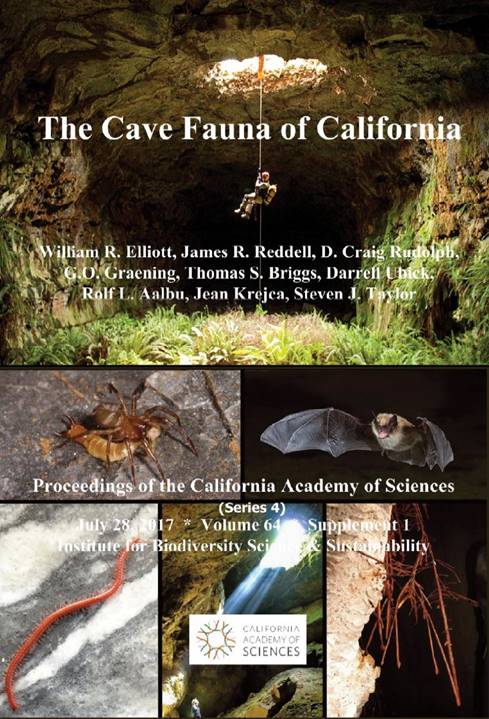 The Cave Fauna
of California is a
biogeographic study by nine authors, published in the
Proceedings of the California Academy of Sciences (PCAS) as a free pdf. The
front section of the 311-page book covers many topics for cavers, scientists,
and general readers. A large literature cited is followed by a species list,
site list, glossary, and index. The well-illustrated book will appeal to anyone
interested in caves, cave biology, history, geology, and California.
The Cave Fauna
of California is a
biogeographic study by nine authors, published in the
Proceedings of the California Academy of Sciences (PCAS) as a free pdf. The
front section of the 311-page book covers many topics for cavers, scientists,
and general readers. A large literature cited is followed by a species list,
site list, glossary, and index. The well-illustrated book will appeal to anyone
interested in caves, cave biology, history, geology, and California.
At least 4,600 caves of all types are known
in California. The book summarizes 1,301 biological sites, with data from 998
caves: (693 karst caves and features, 181 lava tubes, and 124 sea caves), plus
143 groundwater sites and 160 mines and tunnels.
The book lists 1,366 taxa, including 146
obligate subterranean taxa, comprised of 102 troglobites (terrestrial cave
obligates), 12 stygobites (aquatic cave obligates), and 32 phreatobites
(obligate groundwater forms). The species list includes 109 new (currently
undescribed) species of all types.
The richest regions for obligate
subterranean species are the Sierra Nevada, Klamath Mountains, and lava flows
in the northern portion of the State. The high number (72) of single-site
endemic species is indicative of the insular distribution of karst, large
differences in elevation, and the many river systems cutting across the state’s
mountain ranges.
The book includes an
analysis recognizing 20 high biodiversity caves. The top five are Clough Cave,
Samwel Cave, Empire Cave, Clay Cave, and Lilburn Cave. Cave maps illustrate
basic cave structure and interesting ecological features, such as roots, which
are important food sources in the caves.
The
PCAS is distributed as a free pdf file at http://researcharchive.calacademy.org/research/izg/SciPubs2.html.
The pdf is also posted here at www.cavelife.info, the Karst Information Portal, and other sites. A limited
number of printed copies may be purchased through Speleobooks at http://www.speleobooks.com/ and via kpiatek@calacademy.org
William R.
(Bill) Elliott, Ph.D., NSS 10847 HM-FE
914
Bannister Drive
Jefferson
City, Missouri 65109
Abstract
Hidden biodiversity is revealed in this study of
California’s subterranean fauna, which contains distinctive elements that
differentiate it from other North American regions. Since 1975, the rate of
discovery of new species has accelerated with funded projects in most of the
important cave areas of the state, including our own studies. Here we compile
all available biological records for subterranean sites in California dating
back to 1840.
California's karst is primarily comprised of
small outcrops of marble or limestone with thousands of caves. Additionally,
lava and ash flows, tens of thousands of mines, hundreds of sea caves on the
mainland coast and islands, and extensive groundwater systems provide habitat
for subterranean life.
At least 4,600 caves of all types are known in
California, of which 22% have been biologically sampled. We summarize 1,301
biological sites, and analyze data from 998 caves: (693 karst caves and
features, 181 lava tubes, and 124 sea caves), 143 groundwater sites, and 160 mines
and tunnels.
The richest regions for obligate
subterranean species are the Sierra Nevada, Klamath Mountains, and lava flows
in the northern portion of the State. The high number (72) of single-site
endemic species is indicative of the insular distribution of karst, large
differences in elevation, and the many river systems cutting across the state’s
mountain ranges.
In our database 1,366 taxa are recorded; 134
were determined to Family or higher taxa only. There are 102 troglobites
(terrestrial cave obligates), 12 stygobites (aquatic cave obligates), and 32
phreatobites (obligate groundwater forms). Of those 146 obligate subterranean
taxa, 11 are still undetermined beyond Order or Family, and represent an
uncertain number of distinct species, although some may be more than single new
species. Our species list includes 109 new (currently undescribed) species of
all types, including 72 obligate subterranean species: 61 troglobites, 3
stygobites, and 8 phreatobites, significantly adding to the knowledge of California’s
biodiversity.
See pdf of front and back covers.
California Cave Life Symposium
You
can download these educational talks from the Symposium, held on April 28,
2018, at the California Academy of Sciences, San Francisco.

__________________________________________________________________________________________________________________________________________________
A
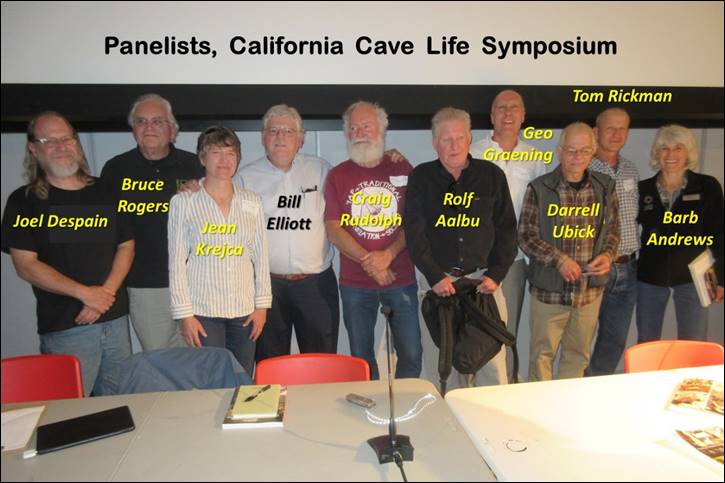
series of 9 slide talks by
William R. Elliott, Shannon Bennett, Geo Graening, Darrell Ubick, Rolf Aalbu,
Jean Krejca/Steve Taylor, D. Craig Rudolph, Tom Rickman and Barb Andrews. With
a book signing and panel discussion by the authors present, Bruce Rogers, and
Joel Despain.
These slide talks were produced with
images and sound tracks, and are copyrighted, ©2018, by William R. Elliott, the
speakers, and photographers. These slide shows are intended for free
educational use. No re-use for sale or reformatting is allowed without written
permission from William R. Elliott, representative of all speakers.
Thanks to all the speakers, panelists,
and photographers: Rolf Aalbu, Kym Abrams, Jessica Blois, Peter Bosted, Dave
Bunnell, Stan Cunningham, Joel Despain, William R. Elliott, Marshal Hedin, Jean
Krejca, Joel M. Ledford, Gary Nafis, D. Craig Rudolph, and Steven J. Taylor.
Below, in chronological order, are
links to PowerPoint files (.pptx) and matching video files (.wmv) of the
recorded talks with embedded sound tracks. The PowerPoint files are more
compact but only play in PowerPoint if one follows the Note below.
Note:
When you download and then open a PowerPoint file,
PowerPoint may give you a “Protected View” with a yellow ribbon near the top of
the screen. It says “This file originated from an Internet location and might
be unsafe.” Just ignore that, click “Enable Editing”, then go to Slide Show,
and click “Play from Beginning”. If you do not enable editing, the slides will
advance automatically, but the embedded sound track will not play.
The video version of each talk (.wmv)
will show on most computers in your favorite media player. Download the files
you want and play them. One can pause, rewind, and fast forward these video
files.
__________________________________________________________________________________________________________________________________________________
1 intro.pptx 14
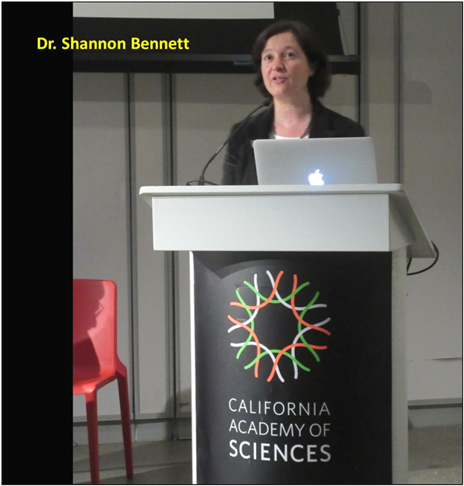
MB, 7:59 (7 mins. 59 secs.). A PowerPoint slide show. Dr. Shannon Bennett and
Dr. William R. Elliott introduce the symposium.
1 intro.wmv
47
MB, 7:59, video format. Download it and play it on your own computer or at a
meeting.
2
Graening intro.pptx 26
MB Dr. Geo Graening, Introducing The Cave Fauna of California. A concise
history of California cave studies and cave life.
2
Graening intro.wmv 165
MB, 29:55
3 Ubick arachnids.pptx 97 MB CAS arachnologist Darrell Ubick, Cave
Arachnids of California.
3 Ubick arachnids.wmv 166 MB, 30:27
4 Aalbu beetles.pptx 69 MB Dr. Rolf Aalbu, Beetles and Caves: Adaptations,
unusual California fauna.
4 Aalbu beetles.wmv 172 MB, 25:28
5
Krejca studies.pptx 57 MB Dr.
Jean Krejca and Dr. Steve Taylor, Cave Biology Studies and Photography at
National Parks.
Jean
shares some of her macrophotography skills.
5 Krejca studies.wmv 137 MB, 25:16
6 Rudolph Conservation.pptx 99 MB Dr. D. Craig Rudolph, The Cave Fauna of California and
Conservation: The New Melones Connection.
Craig
recounts the New Melones Dam project in the mid-1970s and how that led to a
series of field studies and
increased
knowledge of California cave life.
6 Rudolph Conservation.wmv 231 MB, 33:15
7 Elliott biogeography.pptx 51 MB Dr. William R. (Bill) Elliott, California
Cave Biogeography and Biodiversity.
7 Elliott biogeography.wmv 213 MB,
37:44
8 Rickman Andrews Lassen
NF.pptx 35 MB Tom Rickman, Development of a Cave
Inventory Program on the Lassen National Forest. Barb Andrews, the tie-in the
the California
Academy
of Sciences.
8 Rickman Andrews Lassen NF.wmv 77 MB, 13:14
9 panel.pptx 32
MB The authors sign books, then are
joined by guest experts, Bruce Rogers and Joel Despain, to answer questions
from the audience.
9 panel.wmv 232
MB, 35:08
__________________________________________________________________________________________________________________________________________________
Questions? speodesmus@gmail.com
Return to home page of cavelife.info
10/4/2020